


Dear Danielle,
In tech we talk about ownership a lot. You know this as well as I do. We have a dedicated item in our career ladder called “radical ownership,” where folks are assessed on whether they can own initiatives from start to finish, make sound decisions, and ultimately be accountable for the work they lead. It’s often the clearest indicator of how someone’s showing up against the expectations of their role.
However, as we inject more and more AI into our workflows, how far does “radical ownership” extend to your agent’s work too? I’m starting to see individuals and teams lean on AI for their work, then step back from taking full ownership of what the agent actually did. When I talked to them, the argument is always some flavour of “well, I can’t control when an agent drifts,” or “the agent isn’t following my already very detailed instructions.”
I get why people reach for that argument. It’s a lot easier to point the finger at an abstract entity that sometimes seems to have thoughts of its own. (And no, I’m not here to get into AI anthropomorphism or whether we’re approaching AGI or the singularity. That’s a whole other can of worms.)
But my take is that owning an agent’s output doesn’t require predicting its every move. It requires the same thing good management has always required: enough upfront diligence to catch the likely failure modes, and enough review before anything ships to catch the ones you didn’t predict. Guardrails narrow how often drift happens and how much damage it can do when it does. They don’t make an agent’s behaviour fully knowable in advance, and I don’t think anyone should claim otherwise. So if the owner can’t get all the way ahead of an agent’s actions through planning alone, and they won’t always be able to, then the responsibility shifts to putting in guardrails and doing real review of the work before it’s handed off or made available to general access.
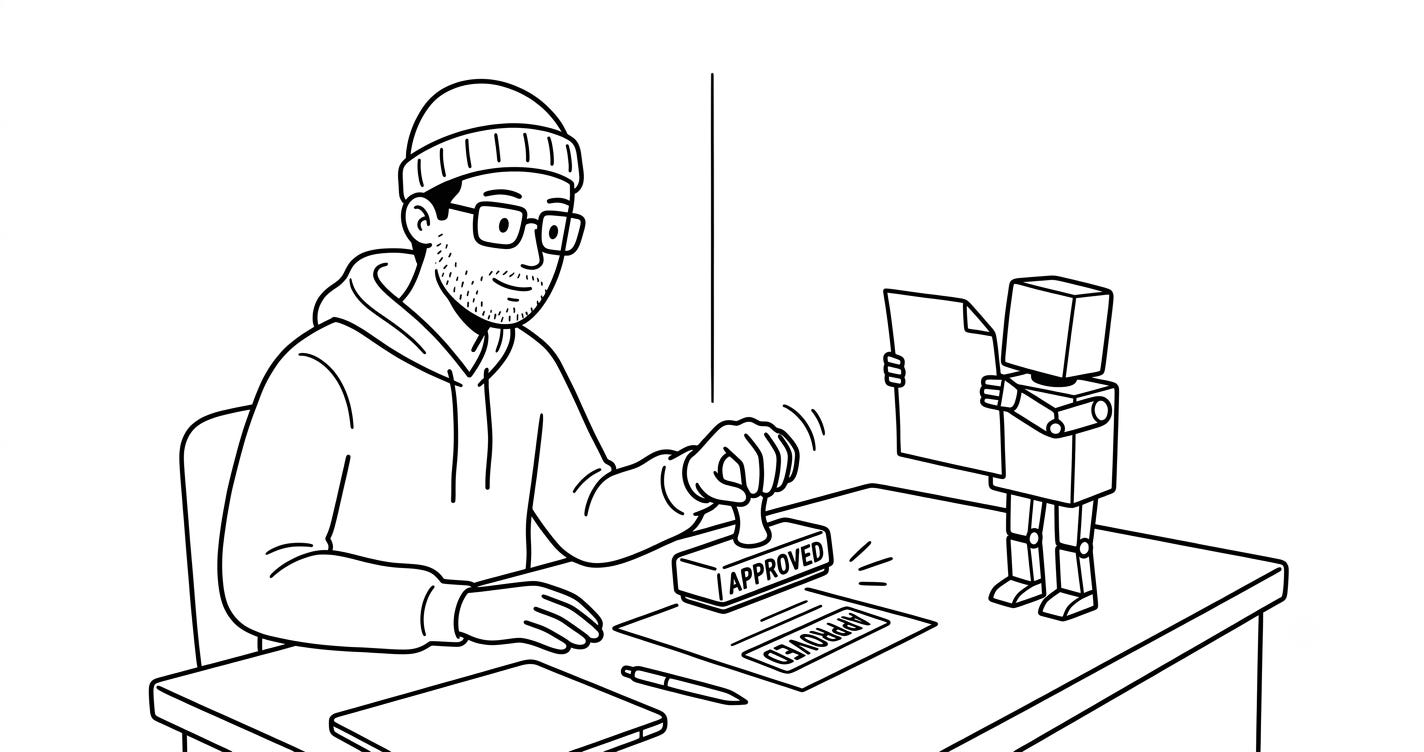
Many people equate using AI with hiring a bunch of interns, and I think the same metaphor holds here too in the context of ownership and accountability. When interns make mistakes, you don’t throw up your hands and say “well, I guess I can’t control what the intern did.” No. You go talk to their manager, because it’s the manager’s job to own the intern’s output. Because when it comes to interns, more often than not, it’s someone senior who puts their name on it and says “this work is ready to represent us.”
Now I’m mostly talking about internal use cases here, where we build agents to power our own workflows, processes and infrastructure. But I think the argument holds for external use cases too, where the stakes are arguably much higher. And this conversation about accountability and ownership is going to land on UX more and more. When our own teams ship agents into our products and those agents drift, who owns that mistake? I think it’s on us: the team who researched, designed and shipped the thing.
Now, I want to be careful not to conflate accountability with zero tolerance for mistakes. Agent drift happens. Learning to spot it, correct it, and build better instincts around it is part of the job now, the same way learning to review a junior’s first pass was always part of the job. As leaders, we need to create room for that learning to happen, not just demand flawless output from day one. But holding space for the learning curve and holding people accountable aren’t in tension. You can be new to this and still be expected to fully own what you ship, including your agent’s part in it.
Here’s the bottom line I think people need to remember: the agent doesn’t get fired. It doesn’t lose customers. It doesn't sit in the room when our work gets critiqued. Agents don’t lose trust with our stakeholders. We do. They have no stake in the outcome. We do.
Ultimately this is about owning the work, and making sure the outcome puts you and your team in the best light, regardless of who, or what, actually produced it. We as humans simply can’t abdicate that.
From blaming autocorrect for a typo I definitely made myself,
Dave
This is the corporate version of “the dog ate my homework” except the dog can write a very convincing essay about why it ate your homework