


Dear Dave,
In my last post I wrote about how a vision is a chapter in the story of a product —1 perhaps lofty and intimidating to start, but its helpful to remember that they’re not the final word.
In this much anticipated squeakquel, or second chapter more appropriately, I wanted to go a layer deeper into what makes a vision effective, and some of the tactics I’ve seen work well.
Qualities of a good vision
A good vision is visionary
This may seem painfully obvious, but many visions put forward a vision of the future that’s only a day away. A vision is necessary to change direction, not to define the chapter we’re in today. It couldn’t exist today with the product as-is. It’s not just building new features: a strong vision drives the product in a new direction that will require a meaningful gear shift to achieve. It tells a story about what the product can become for users — solving new problems we didn’t know we could, or in novel and unexpected ways. This matters because a vision needs to be ambitious — otherwise its just an idea, which is always nice, but any product team worth its salt wants its direction to be trailblazing.
It’s evidence-based but highly opinionated
A good vision is grounded in customer research and data. But those things can point us in multiple directions. A strong vision is controversial — other visions are possible, but we choose this one, and the vision articulates why, and persuades you to agree. This matters because a vision is only as good as the evidence that underpins it, and because it’s a stance, by definition, it has to drive towards a single clear path, not describe several options.
It’s concise and memorable
A lot of work goes into a vision, but what you need to consume to get it should be limited and sticky. It should probably, in all seriousness, have a snappy tagline or title people can refer to. It is a simple enough direction to be summarized, even if there’s plenty of content to go through if you want to go deeper. None of this works if the audience can’t hold onto it, and the audience for vision work is likely wide and busy. To be relevant and enduring, the vision has to be easy to describe and recall.
A spectrum of vision artefacts
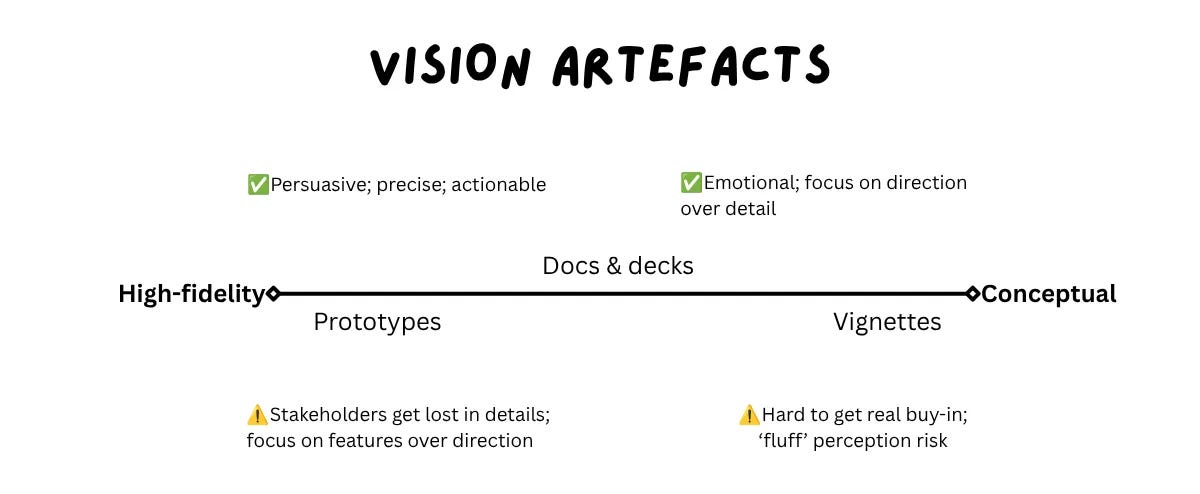
Next I want to share a non-exhaustive list of common vision artefacts, in no particular order, to show what this blobby-feeling thing actually looks like. All of these can work, and all can fall flat. And often they’re best used in combination with each other.
Prototypes
While visions prototypes increasingly proliferate thanks to our friend AI2, they rarely pass the visionary bar — often falling into the trap of showing a collection of new features we could build, rather than a true direction.
Still, prototypes can be incredibly powerful because they are the epitome of ‘show rather than tell’. They can be highly persuasive for executives, but team members may look at them with skepticism. Voice-over or embedded storytelling is critical to ground everyone in reality with an artefact that looks so real — and to make clear you’re not trying to ship this exactly, but in this direction, which can breed confusion at all levels.
Documents and decks3
There remains a place for tried and true handcrafted words in vision work; this enables you to articulate the principles and frameworks that should drive the chapter ahead in vivid detail, and to get into the evidence behind them. And with agentic design, documents in particular can serve as useful tools to enable AI tools to work towards your vision, too. Words are back in style and more powerful than ever!
But, though they enable you to be precise in theory, words are open to vast interpretation and misunderstanding, by humans and agents. They also frequently require people to read things; some people will do this, but many will not4.
Especially for a vision generated by a UX team, it’s rare that these will do on their own for humans without being accompanied by visuals, but when the narrative is complex, requires technical detail or this is the best approach for your audience, the key element here is to be concise5 and clear, even though the format invites you to do the opposite.
Product vignettes
A version of a deck in practice; by product vignettes, I mean a story told through moments in time in a product. This is particularly useful to convey how product usage could change over time — on day one, the user does X; on day 30, they do Y. This approach is more emotional, leaning into storytelling and showing the role of a product in users’ lives.
Often we use wireframes here or product illustrations rather than real UI, focusing on specific evolutions and how they impact user behaviour.
This is compelling, but risks feeling ‘fluffy’. Technical leaders think it sounds lovely, but don’t know what to make of it in reality; it doesn’t provide as clear or detailed of a path from here to there. This might be intentional, but will mean getting buy-in might take a lot of clarifying around what exactly we’re looking at, and what comes next.
A last word to the wise
An important caveat on all of the above: when I was getting married a good friend gave me the advice that “the seating chart will tell you what to do” — meaning how to arrange your people amongst your tables will become clear as you go.
This struck me as true well beyond this context — your vision work will tell you what to do, i.e. what form your vision should take. First and foremost, go with what you are hearing from the people who will consume it. Treat the vision itself as a product; the people who use it are the ones who will tell you if its working; and as far as the agents who consume it, you’ll need systems to evaluate that yourself!
Either way, the work isn’t done when you share the thing — its how vision becomes reality, whether and how the chapter you’ve written get codified in the experience and influences what comes next.
From gazing into the future, thinking life could be a breeze,
Danielle.
With vibe-coding, prototypes and demos are having their moment in the sun — in the past I might have said they were too high-fidelity for vision work, but high-fidelity is the new low-fidelity. Meaning understanding the actual state/conviction of our work is increasingly opaque. But this is a different blog post!
Remember these? Good times.
Agents will though! Woohoo for words! An oft-repeated phrase in tech is “people don’t read” — but agents are out here consuming all the words we put in front of them, and then some.
Another agentic caveat: more concise may not be better for this insentient audience. Clearer certainly is!