


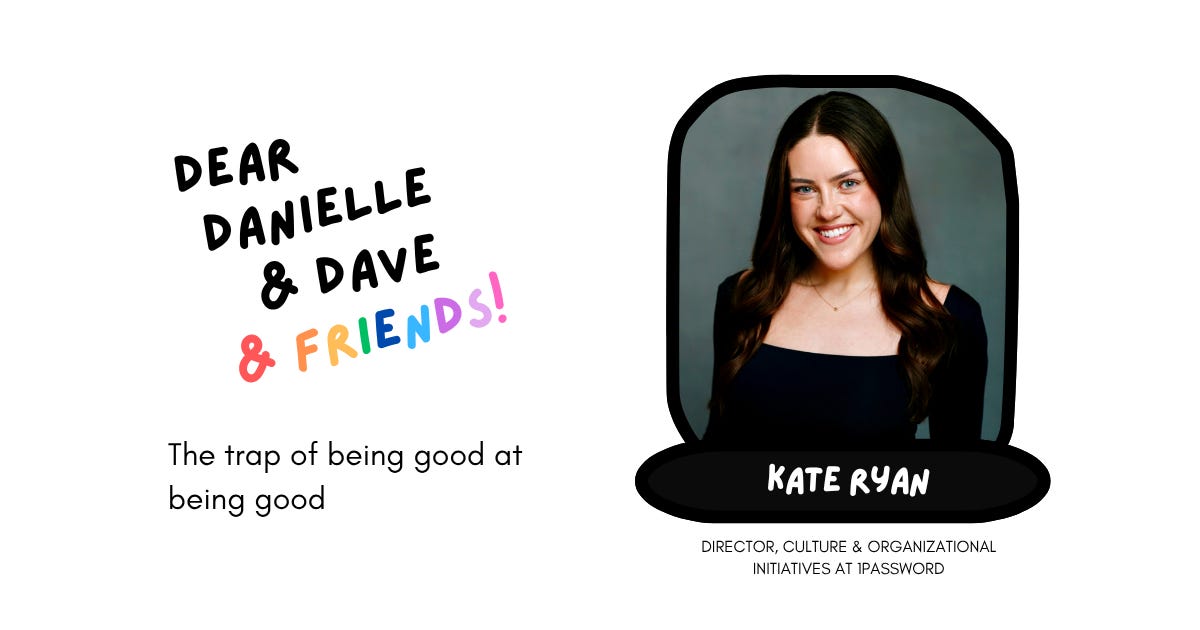
This week’s letter is brought to you by our brilliant colleague Kate Ryan. Kate is Director, Culture & Organizational Initiatives at 1Password; in other words, she makes our work great to do everyday. Before moving into employee experience, she has a background in sales and customer success, and is a card-carrying Theatre Kid.
Dear Danielle and Dave,
I’ve been belting out show tunes since I could speak. I got an acting degree, wildly expensive headshots, an agent, and then made a genuine attempt to “make it.”
What followed was a humbling education in what making it actually required. (There was also a year as a Disney birthday party princess. Separate letter.) (Editor’s note: WE NEED THIS LETTER!)
By 23, I’d made peace with the pivot, landed my first corporate job as a Business Development Representative, and discovered something unexpected: everything translated. It turned out that reading a room, holding attention when the energy shifts, and showing up composed when you’re not were not only stage skills, but enormously useful in meetings, presentations, and cross-functional conversations.
That translated skill set became the foundation of a decade of career growth.
It also, somewhere along the way, became the whole story I told about myself.
I leaned into it, and it worked. I built things. I read rooms very well. I got promoted — a few times. I got good at being good at work; and more than that, I understood why I was good at it. I began to know my competitive edge; what I didn’t notice yet was that I was also starting to become it.
There’s a difference between being good at something and that thing being the only role you can play. Knowing I could read a room and show up prepared stopped being a skill I had and started being who I was.
It showed up in small ways I didn’t clock until I started looking back. I almost never said “I’m not sure” in a meeting. I rarely let people see me working something out in real time. If I didn’t have a fully-formed answer, I’d hold the question until I did.
Being polished became non-negotiable, not because anyone asked for it, but because I’d stopped being able to separate the skill from the person doing it.
I’m eleven years into my corporate career, and I’m reflecting on what kinds of skills are actually required for the leadership level I’m now at. Realizing that skills are, in fact, just skills has been a reminder that growing as a leader involves pausing to ask what each skill is in service of. The most interesting leadership work, I’m slowly learning, starts when you let people see more than the finished version.
My identity is bigger than any one thing I’ve refined over the past decade, and so is the work.
Somewhere between the birthday parties and the corporate offsites I’ve learned a lot, but many parts of me are still in rehearsal. As we know in the theatre world, that’s where all the real work happens.
From a retired birthday party princess,
Kate
Subscribe to Kate’s substack Fine, But Feeling Things for more of her writing. 💙

"Skills are just skills" - not to make this ~ about AI ~ but right now something we're all contending with is how what's needed for our roles is changing with AI being able to do some of the things we do. I love this letter so much - thank you Kate!