



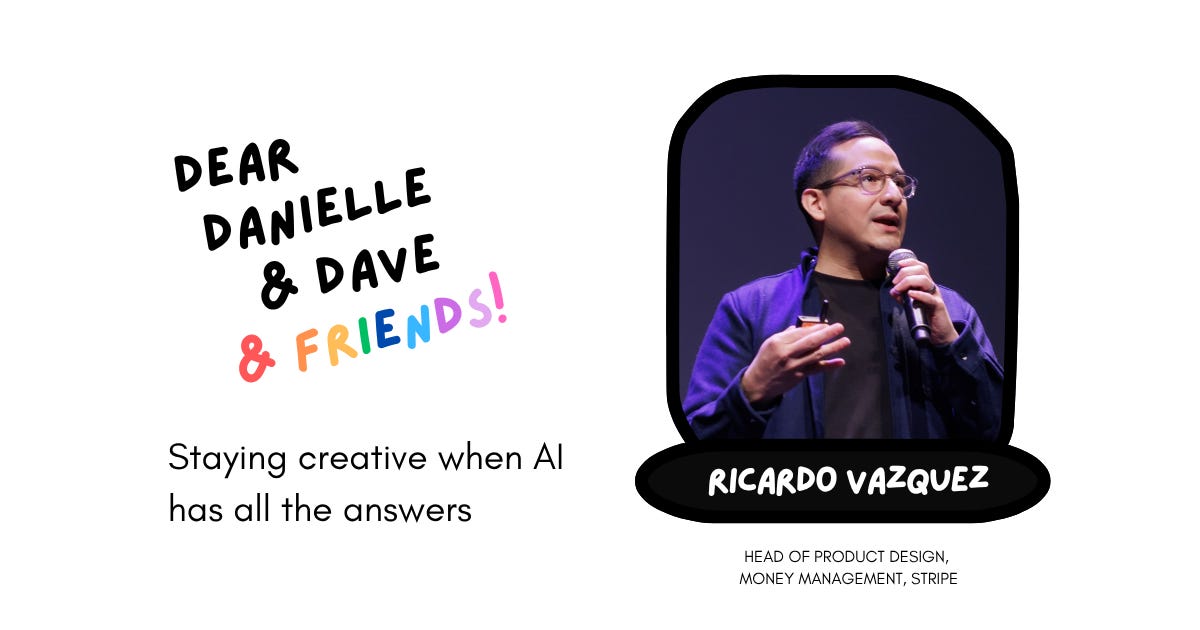
Ricardo Vázquez is a playful person. His infectious, optimistic energy is a hallmark of his leadership. It’s no surprise he wanted to talk to us about the role of play in creativity — and what happens to that spirit with AI in the mix always ready to give you the straight and narrow answer.
After his time at Shopify, Ricardo and Danielle worked together at Wealthsimple; more recently he’s led design teams at Dropbox and now Stripe, where his team is working on what a payments company can become beyond payments.
Alongside all this, Ricardo has a playful two-year-old at home who keeps him busy, and full of imagination.
Below is an edited summary of our conversation.
🎧 You can listen to the full conversation on Apple Podcasts, Spotify, or wherever you get your podcasts.
We discuss:
Why quality and craft have almost nothing to do with pixels
The difference between a system that exploits and a system that explores, and why AI defaults to the former
How to lead a team through that tension without just telling people to “be more creative”
Why so many of us have lost the ability to sketch, and what to do about it
What a two-year-old can teach you about where invention actually comes from
What does quality mean to you?
In tech right now there’s a gigantic movement toward craft, taste and quality, and I believe quality extends well beyond the pixels. Beyond the border radius, beyond visual depth. It extends into the definition of the problem: who are we solving this for, why are we solving it, and have we diverged as much as we need to? There’s craft in what gets left in a sketchbook, or in a meeting room, or in a jam between two people.
A loading state that loads quickly is quality, too. I’m on a bit of a crusade to mature my own understanding of it, and I usually end up talking about everything except the micro-interactions.
Stripe’s made several acquisitions. How do you hold the quality bar when different products come together?
At Stripe, my group is working to invert the value proposition. Stripe is famous for processing payments, but our users have other jobs to be done. Say the three of us own a bookshop. Sure, we process payments, but we also have vendors all over the world to pay, and money sitting in several currencies. And with stablecoins finally maturing into something usable, we’re building a brand-new banking rail. It sounds like just financial technology, but there’s endless creativity in abstracting that complexity away.
The hardest thing I did at Dropbox was bring three brands into one. Everyone asks what you keep and what you let go, and I think that’s the second question. The first is the job-to-be-done, from the user’s point of view. If an acquisition is treated as a side benefit, or as a separate product under one flag, you miss the chance to find its home in someone’s end-to-end journey. Once you know where it helps, you know which IP, which interactions, which environment to carry over.
The most successful we got was when we stopped thinking of two playgrounds. It was one, and our job was to work out which corners to lengthen.
It also takes patience. And that’s where I think play is at risk right now.
Say more about that. Why is play at risk?
There’s a paediatrician, Donald Winnicott, who described play as a child taking a sample of their dream potential and pressing it into reality. Two worlds touching. That’s where new things come from. It takes courage and patience, and as adults we narrow. We’re trained to focus on what’s relevant today, and that closes the door a little more each time.
Another way to see it: are you a system that exploits, or one that explores? A system that exploits narrows to whatever serves its goal right now. It’s focused, and fast. A system that explores ventures outward and gathers things that might not even turn out to be relevant.
We’ve always offloaded small jobs to tools. A calculator, a map. But we stayed in the driver’s seat. We checked the work and steered. AI is different. Researchers have coined a term for what we risk doing with it: cognitive surrendering. You accept the machine’s reasoning wholesale, with no challenge and no verification. Used that way, AI is the most powerful system of exploitation we’ve ever built. It gives you the fastest answer, the safest answer, the one that already exists.
Think about the last time you played with AI and it felt magical, when you were in flow. I’d guess it’s seldom. Now think about the last book that made you cry on the train. Those aren’t the same experience. But I don’t think this is fate. It’s a choice.
As a leader, how do you protect that choice on a team with real deadlines?
By admitting that efficiency isn’t free. Its side effect is tunnel vision, and a velocity culture prunes exactly the wasteful wandering creativity runs on. You can’t fix that by telling people to play more, because play needs a container and it needs time. So I frame the work as an adventure, sometimes literally a hero’s journey. Exploration is expected, not something you quietly sneak in. And I measure discovery differently from delivery, because you can’t put a velocity number on exploration.
The urge to exploit never needs my help. It’s the urge to explore that fades unless I protect it. My job is to be the fence around the playground, and to explain to stakeholders why time spent diverging is worth it.
The real risk is a designer who is exploring but stuck, diverging without converging. What I listen for is the why. If someone can tell me why they’re chasing something, even when the how is still messy, that isn’t stuck. It’s motion. Stuck is motion with no why.
What about the opposite problem? A lot of us have stopped sketching. Starting a rough idea feels vulnerable, and everything now starts in high fidelity.
I’d love for us to get back to more analog ways of working. I don’t think we’re there yet. I bought coloured pencils the other day, but that isn’t a scalable path for designers.
It starts with psychological safety. I have a toddler, and he’s my best teacher. He doesn’t see boundaries. He sees opportunity, and he doesn’t fear failure. Imagine bringing even a little of that into daily work. But it takes a leader going first: “I tried this, it didn’t work, and gosh, did I learn something.” Little by little you build a culture that celebrates the path someone took regardless of the destination.
Second, I don’t want to fight the fact that people start in AI now. That’s the movement. Think of AI as a doorway. The key you use determines which world you walk into. If the key is “just give me the solution, build the prototype, go,” you get one room. I want a different key. I built a Claude Skill called PlayPartner. It isn’t there to think for you; the why stays yours. It’s there to hand you a hundred maybes so you can go hunting for the one that surprises you. It’s the difference between shooting hoops alone and having one more person on the court.
As leaders, we’re always telling people what not to do. Where does invention actually come from?
Kids marvel at the mundane. My two-year-old will open the dishwasher and slide the rack back and forth, just watching the rail move. I used to close a tap so that exactly one drop fell. We nudge people out of that: “don’t waste time on that, go create something.” I try to lean into it instead, by rewarding mimicry.
There’s a woman, Windy Chen, who left Google for a sabbatical with one goal: tie a new knot every day for a year. At first she mimicked. She mined every knot book and guide she could find. Somewhere in there, she stopped asking existing knots for answers and started inventing ones that had never existed. She never went back to tech. She’s an artist now, with rope installations around the world.
It’s the Steal Like an Artist idea. Copy first, then invent on top of it.
Lightning round
Best leadership advice you’ve received?
Two years into my career I had a serious case of overconfidence. I’d just joined FreshBooks, and one of the first things I did was submit a PR changing the link colour on the landing page from that Microsoft-95 blue to something nicer, because obviously I was right. Casey, the director of product, said: “Great, your environment works. Now bring me research showing users need this.” I was baffled. A few weeks in, I told him I wasn’t sure it was the right place for me. He said, “Tomorrow, leave your ego at the door.” and walked away. It reframed my early career. I became a designer who observes first and asks why before offering the answer.
Work bestie shout-out?
Toby Negele, a designer at Shopify. We partnered on reimagining point of sale from opposite ends of the spectrum: he lived in the technical detail, I lived in the storytelling and bringing teams along. He listened to metal, I listened to Broadway. It worked, and he’s a dear friend now.
Anything to plug?
My star project right now is raising a human being. But my plug is this: read. Buy a book and submerge yourself in a world someone else wrote. Don’t read a PRD, for God’s sake.
Thank you, Ricardo, for reminding us to have fun and leave our egos at the door! You can find Ricardo on LinkedIn.