


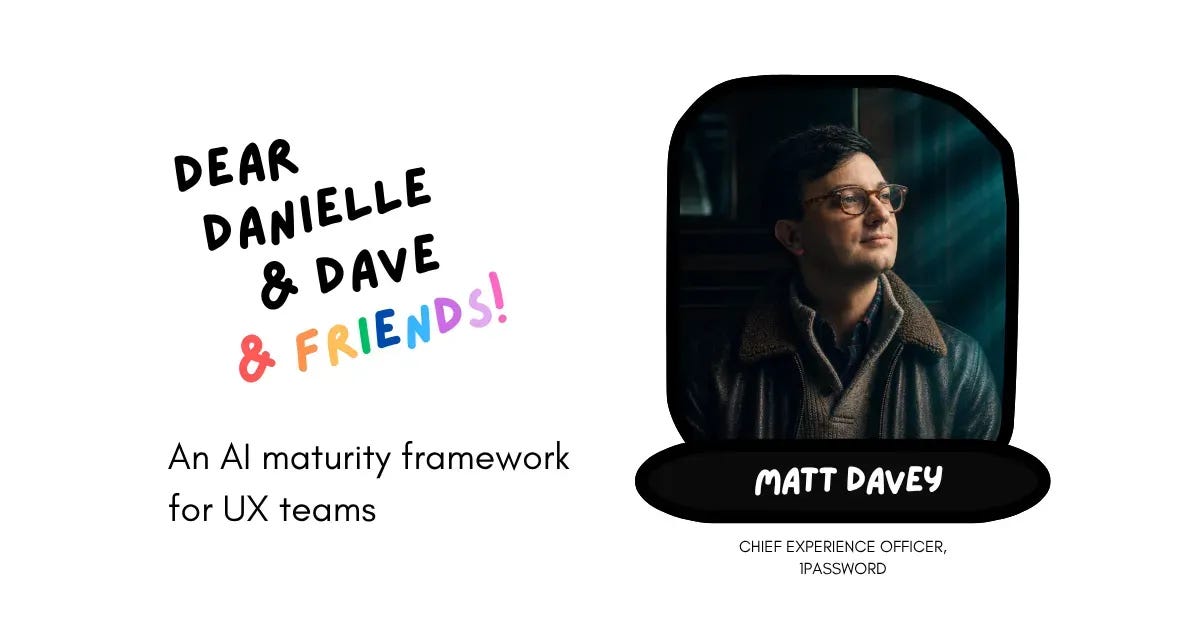
Meet our boss!
In this very special edition of Dear Danielle & Dave & Friends, we sit down with Matt Davey, Chief Experience Officer at 1Password, and the person who has to put up with our antics daily at work.
Matt says the three of us are like “peanut butter, jelly and mustard” (not derogatory?). We think this makes for a pretty great combo — and this conversation will give you a glimpse not only into Matt’s point-of-view, but also into how the three of us lead together.
Matt has led the user experience team for a whopping 14 years. We are both part of the org he’s spent over a decade building alongside cycling through his many eclectic hobbies for much briefer stints, such as printmaking, radio, chocolate-making, 3D printing, biking, and surely many more. He also cohosts 1Password’s security podcast, Random but Memorable, and has his own excellent blog on design & leadership.
Recently Matt went viral on LinkedIn with the AI maturity model he developed to assess UX maturity in the age of AI (which was subsequently expanded by Jakob Nielsen - no big deal). We had a conversation with him about just that, hiring, and much more.
Below is an edited summary of our conversation. This is a longer ep with lots more in the pod, including clues to the blog title, so be sure to listen!
We discuss:
Why AI has raised the floor of design work without yet raising the ceiling
The art-to-science hiring philosophy behind our team, and why AI is making the middle of that spectrum fall out
Why his viral design maturity model isn’t a career ladder
His long-standing allergy to frameworks, and why he built one anyway
What it actually takes to lead a team through “full steam ahead” when nobody’s sure the ground will hold
You’ve built our team around the idea of a spectrum, from the art side of design to the science side. How has AI changed that?
I’ve always thought about design as a spectrum — there’s a playful, art-driven end and a more rigorous, science-driven end: the behavioural loops, the IA, the strategic “we’re building this to solve that” side. AI has basically made the middle of that spectrum fall out, because you can now go so much deeper into one side or the other. If you really enjoy the behavioural loop side, nudging users toward something, figuring out the flow of information, you can now do that with quantities of data you’ve never been able to deal with before. And the same is true on the other end — you can lean all the way into becoming a front-end developer while still holding design as a craft. I don’t think you can do both anymore, and honestly, I’m not sure you ever really could.
When I’m hiring, I look for the thing that makes someone’s face light up when they talk about one specific part of the job. I think almost everyone great on our team has one of those things, and we try to give them as many problems shaped like that as we can. Going deeper into AI has mostly just made people go deeper into one area of that spectrum, rather than smoothing everyone into the same shape.
There’s a real risk there too, though — that AI just makes everyone competent at everything and nobody exceptional at anything. How do you coach people to double down on what makes them distinct?
AI has definitely raised the floor. It hasn’t yet raised the ceiling in everyone’s hands. I think where people end up specializing versus smoothing out comes down to expectations. If you care about interaction design and getting something finessed and perfect, and then you go to content design and just accept whatever the model gives you, that’s the split — some people are using it to get better at the ten percent that’s genuinely hard, and some are using it to cover everything at a mediocre level. Both are happening. But the really great work comes from people using it to move that last ten percent, not to try to do it all.
That does mean staying flexible about what you think you’re hiring for. I’ve changed my mind about what we’re looking for more times than I can count, because a great person shows up who lights up over something completely different than the role on paper. You’ll regret filling the hole. You won’t regret hiring someone great, even if they don’t perfectly fit the shape you had in mind.
Your AI design maturity model went viral in design circles. What do you think it was about it that resonated?
Honestly, I almost didn’t post it. I was going to keep it just for us to use as a reference. I ended up sharing it because another VP asked how I was thinking about our AI adoption, and I sketched something rough in FigJam — here’s roughly where we are, here’s where I’d like to be. Having that basis for a conversation, even if the model itself is wrong, turned out to be one of the more useful things I’ve done.
I think it landed because so much of the AI-and-design conversation has been relentlessly negative — “AI can make a rectangle, we’re done,” “PMs can prototype now, that’s us finished.” It’s not nuanced, and it doesn’t give anyone anywhere to stand. The model gave people a place to say, here’s roughly where we are, here’s where we want to go. It resonated because it was a way out of the doom spiral, not because it was right.
You’ve said before that you hate frameworks — and yet here you are, having built one. How do you square that?
I really do hate frameworks, if I’m honest. I understand why we need career ladders, why we need some objectivity in measurement. But a sports team is probably the better analogy — you can have the best chess pieces on the board and still lose, because the outcome is judgment, constantly, not just the individual pieces. That’s why the one thing I didn’t want the maturity model to be was a career ladder or an expectation placed on an individual. It’s a level above that. If someone doesn’t do well, it could be the tooling around them, the maturity of the team, the delivery process — none of that is necessarily on the person. Frameworks tend to fail because they assume everyone is in the same place, skilled in different ways but played in exactly the same position.
What’s your advice to leaders trying to convey confidence to their teams right now, when so much is genuinely uncertain?
Part of me wonders if I’m the wrong person to ask, because I probably went into this with something verging on overconfidence. I ran when I probably should have jogged. But I think that’s what the moment required — if the person leading the charge isn’t confident, everyone else just defaults to “this seems bad, let’s avoid it.” We ran an offsite where we asked people to ship something to production, and the wave of emotions in that room was real — panic at eighty percent of the day gone, then euphoria once things started working.
I think the job of a leader here is to have an opinion, grounded in something real, and to actually push forward with it rather than adjusting constantly, because constant adjustment doesn’t build anyone else’s confidence. But I was careful not to turn that into a scoreboard — I originally wanted to track who’d shipped a PR and who hadn’t, and I’m glad I didn’t. Everyone’s learning curve with these tools is different. It’s on leadership to prove the tools are useful and show how, and then get out of the way.
Lightning round
Best leadership advice you’ve ever received?
The problem with getting advice after being in a role this long is that every piece of it was really good for one specific era, one specific scale, and none of it ages well. So the best advice I’ve ever gotten is: start again. Break down your role and rebuild it as often as you need to, because anything you hold onto too tightly slowly deteriorates — a critique format, a team newsletter, anything. Throw out advice the moment it stops working.
Who’s a work bestie who’s helped you along the way?
Our colleague at 1Password Matt O’Leary. He’s an incredible soundboard — optimistic when you need him to be, but never a false positive, so you always know when he actually means it.
Huge thank you to Matt for joining us and sharing some truly wise words; and we’re not just saying that because he is our boss, we swear!
Matt’s building a trivia game called Cloakword, where you’re given an article with the title redacted and have to guess it from the clues. It’s free to play, though he’s kind of hoping it doesn’t go too viral, on account of the API bill.