


Dear Danielle,
Human memories are short and fickle. We remember feelings more than facts. We remember that something was hard, but not always how we got through it. And in the workplace, where change is constant and relentless, this becomes a real problem — because if we can’t remember how we navigated the last big shift, we’re starting from scratch every time a new one hits.
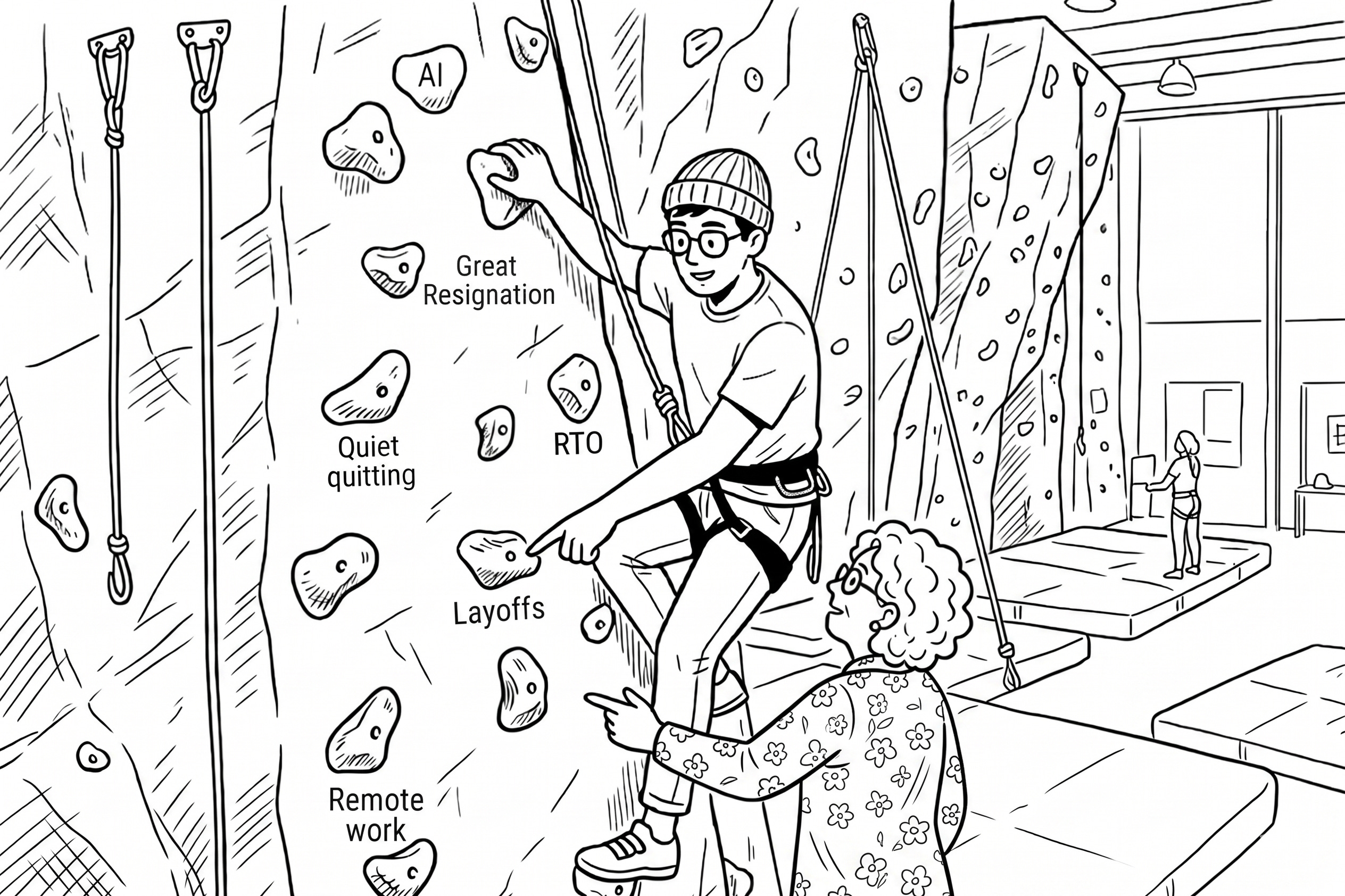
Think about the last five years. In 2020, virtually every knowledge worker on the planet was sent home overnight with a laptop, a Zoom license and a prayer. We had to figure out how to work remotely, how to collaborate through screens, how to manage teams we couldn’t see. Work and life melted into one. Some of us thrived. A lot of us burned out. Then in 2021 came the Great Resignation — millions of people deciding, almost all at once, that the deal they’d been accepting wasn’t good enough anymore. They wanted more flexibility, more purpose, more respect for their time. The leverage shifted to workers, and for a brief window, it felt like the rules of work had permanently changed.
By 2022, the mood had shifted again. “Quiet quitting” entered the lexicon — people drawing hard boundaries on effort, rejecting the idea that their job deserved anything beyond what was in the job description. Then 2023 brought the correction. Tech layoffs. RTO mandates. The “Big Stay,” where people stopped quitting — not because they were happy, but because the job market had cooled and the leverage had swung back to employers. And through 2024 and into 2025, we’ve landed somewhere that feels heavier than any single crisis: a kind of collective detachment. Engagement at historic lows. Trust in managers and senior leadership declining year over year. AI-driven layoffs. DEI programs being quietly dismantled. Workers stuck and resentful, managers burned out and second-guessing themselves. In the process, many companies lost many good people.
That’s a lot of change in a very short window. Most of us lived through all of it. But if I asked you to describe exactly how your team navigated the shift to remote work, or how you helped someone process the anxiety of the Great Resignation, or what you specifically did when your org went through its first round of layoffs — I’d bet the details are fuzzy. You remember it was hard. You remember some of it worked out. But the lessons didn’t stick, because nobody stopped long enough to name them and write them down.
Which brings me to where we are right now with AI.
With any change, there’s the change itself — the adoption of new AI tools, the mandates from leadership, the restructuring of roles, the layoffs tied to automation. That part is real, and it’s disruptive, and it deserves honest acknowledgment.
But I think the bigger miss for leaders right now isn’t how they are managing the change itself. It’s that many leaders are treating AI as if it’s the first time our teams have had to adapt to something massive and uncertain. “But this change is different!” some might say. In some ways it is, but fundamentally it really is not different. We’ve been doing this, over and over, for five years straight. Much longer in human history.
And yet every time, it feels like we’re starting from zero. Because we are forgetting that with any change, there is also the teaching of the change. That’s the piece that’s been missing. Many leaders have only been managing changes through each individual instance of it.
There’s a real difference between those two things. Managing someone through a change is reactive. It’s “here’s what’s happening, here’s what it means for you, here’s what we need you to do.” It’s necessary. But it doesn’t build capacity or resilience. It doesn’t leave people with a transferable skill they can apply next time.
The teaching of the change is different. It’s helping your team develop the muscle to sit with uncertainty without freezing. It’s naming the pattern out loud — “we’ve been here before, and here’s what we did, these were the lessons we learnt, and this is how we can approach change this time.” It’s being transparent about your own process of figuring things out, not just the conclusions you’ve arrived at.
So yes, help your teams adopt the AI tools and adapt to shifting expectations. But don’t skip the part that actually compounds. The ability to process change is cumulative — but only if you actually process it, rather than just surviving it and moving on.
The change will keep coming. It always does. What your team remembers won’t be the tools you adopted or the reorgs you weathered. It’ll be whether anyone taught them how to steady themselves when the ground moved — and gave them the language and tools to do it again next time.
From trying to find literally anything in Google Drive,
Dave