


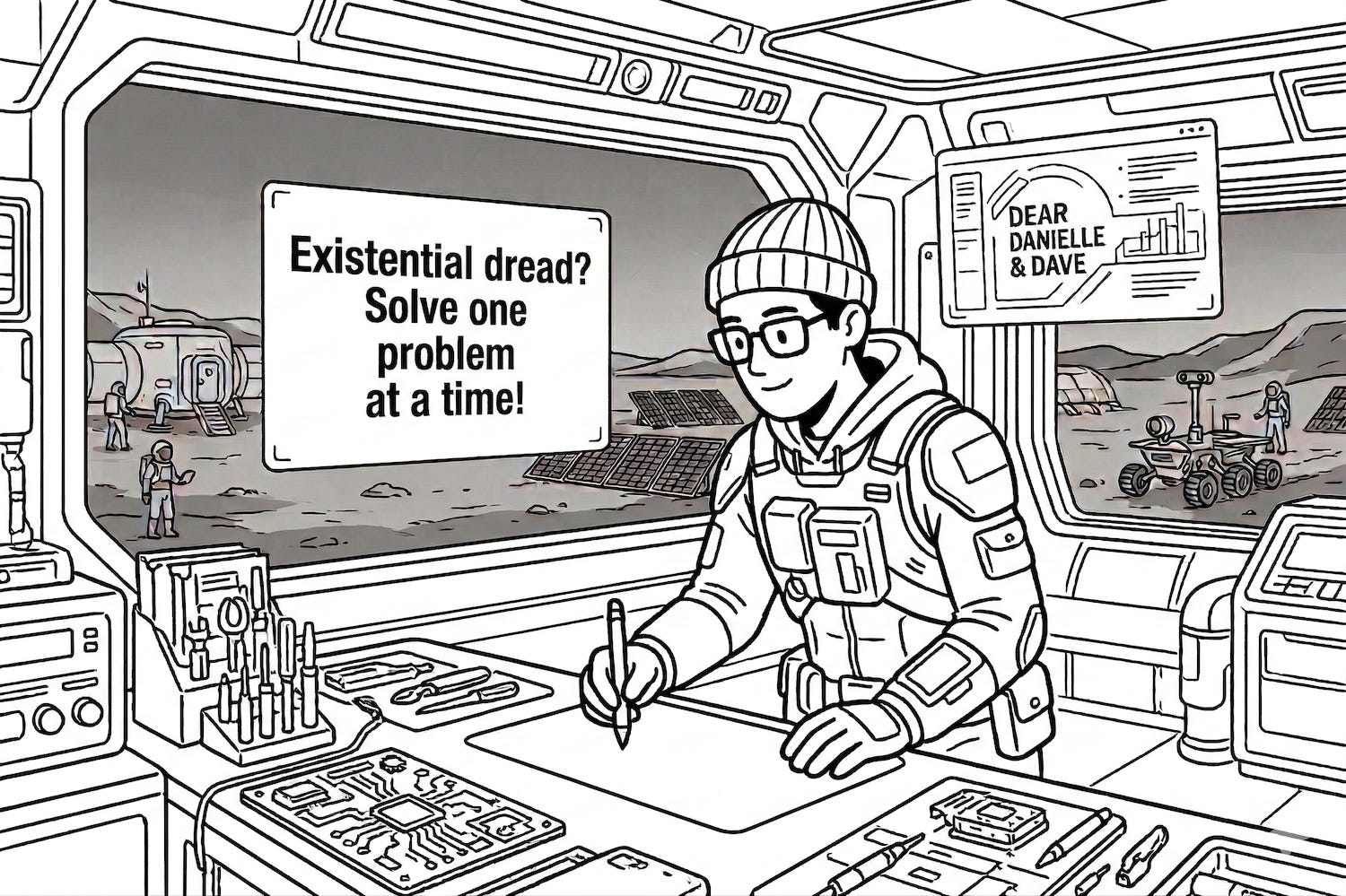
Dear Danielle,
There’s been a lot going on.
Many org and leadership changes, shifts in priorities and focus areas, team turnover, not to mention the broader geo-political environment and worldly events. Oh, and of course, the impact of AI on the industry, on how we work, and everyone’s excitement and anxiety around that.
All of this is happening on top of the personal responsibilities and events in our lives — parenting, civic duties, sickness, births, and deaths in the family.
Some of this is very exciting. Some of this really sucks.
This year, I can sense the general overwhelm in our teams as a result. Much more so than previous years. And it’s only March 🫠.
All of this leads to a feeling of existential dread. The feeling that the “problem” is insurmountable. Not any one particular problem, but the cumulative weight of all of them.
It chips away at people, eats away at their optimism, and builds up cynicism.
In tech, we often talk about chunking up a large problem into smaller, more manageable pieces so they are easier to tackle programmatically and technically, which allows the team to ship things faster out to our customers.
This approach of breaking down the big problem into smaller, more manageable pieces is the approach I believe we should take when faced with this “existential dread.” Instead of being paralyzed by the sum of all the problems, compartmentalize and address each one in a prioritized list, and work on whittling it down over time.
It would be a good time to mention that sometimes you won’t be able to solve the problem directly yourself, as you have little to no control over its course. For instance, certain organizational changes are very much outside of our control. What you can do, however, is control how you respond to the outcome of those changes. Approach the problem with curiosity, seek to understand, figure out the part that impacts you, and find a way to solve that part of the problem.
I’m mindful not to provide specific solutions as we all face vastly different problems at our work and in our lives. Instead, I’m going to cite The Martian (one of my favourite movies in recent memory, btw) to illustrate this point. Also spoilers ahead, but this movie is more than 10 years old now, so if you haven’t seen it, I can’t help you 😅.
In the movie, Mark Watney was faced with insurmountable odds of surviving by himself on the red planet — he had no way of communicating back to Earth to tell people he was still alive, he needed help from other experts to devise a survival plan, he was running out of food and water, and he needed to get off that planet.
Did he feel hopeless and a literal existential dread? Yes, of course.
But instead of being paralyzed by the problems, he broke all the problems down and tackled one obstacle at a time until he made it home.
The final scene of the movie brings it all home (pun intended).
“…You can either accept that, or you can get to work. That’s all it is. You just begin. You do the math, you solve one problem, then you solve the next one, and then the next, and you solve enough problems, you get to come home.”
From helping my 8 y/o with her math problems at the dinner table,
Dave
Dave, you’ve hit on the most expensive mistake teams make during a "loud" year: Mistaking a big problem for a single problem.
Existential dread is rarely about the scale of the work; it’s about the feeling of stagnation. When a goal is planet-sized, the "big picture" stops being a North Star and starts being a weight. Momentum is the only thing that lifts it. You have to have the courage to ignore the "insurmountable" for a moment and focus on the quick wins that get the wheels turning. Once a team feels they can actually move, the dread starts to dissipate—not because the problem got smaller, but because the team got faster.