


Dear Dave,
What do you think of when you think of user experience quality?
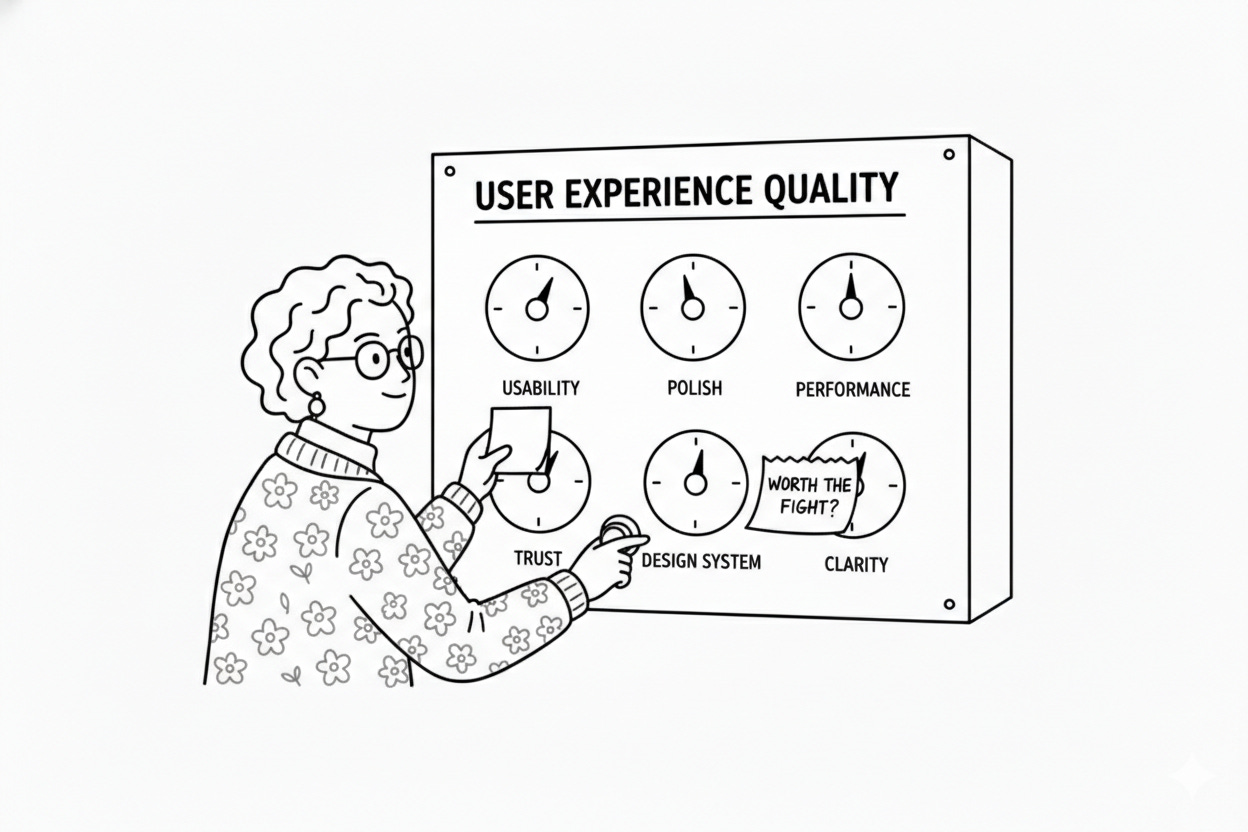
Some people’s minds will go to usability and accessibility; others to polish and the fine details; others to design system adherence, performance; and still more — and all of us would be correct.
Quality is the sum total of the user experience. Hand-in-hand with trust, when quality is high, the product just works and you may not notice it because your job simply gets done. And when quality degrades, things feel broken, and you question whether you’ve got the right tool for the job in the first place.
Quality is an outcome of our decision-making. It reflects our priorities and the bar that we choose to set. Ideally, we have systems in place that enable a consistent bar for quality across the product; in practice, quality decisions often sit with individual people in individual moments, alongside a host of other, conflicting priorities. The question for a designer then often becomes what battles are worth picking: where to push to raise the bar, and where to let it go.
All the more interesting now is how AI plays into these conversations, where its becoming increasingly possible for designers to get into the codebase ourselves and lift quality.
In that context, I think it’s all the more important to consider quality as a reflection of the quality of our decision-making. So the opportunity for UX leaders is to foster strong decision-making skills.
10 years ago (!) Julie Zhuo wrote: “intentionality is a hallmark of good design.”
Much has changed since then but this holds entirely true to me, especially with the introduction of AI design. From the start of solving a given problem, did the designer approach each decision with intention? The nature of those decisions is changing with high-fidelity AI prototyping now often kicking off the design process — but of course such prototypes are tools for decision-making themselves.
High-quality design is borne of high-quality decision-making, which considers multiple perspectives, data points, references, past experiences and more. AI enables not only faster outputs of ideation but wider inputs to it.
Fostering high-quality decision-making is the role of any leader, and alongside championing systematic approaches to quality across an organization, is the most empowering way for UX leaders to foster quality among their teams — moving from ‘escalate the conflict to me,’ to ‘make the call, and tell me why’. The decision then of when to push for quality and when to let it go is less the core decision to focus on, versus being able to evaluate a designer’s decision-making overall through the lens of their process and the various inputs that informed each decision along the way. This is where we can give feedback and direction that truly unlocks growth and makes the next set of decisions stronger.
I’m focusing here on quality at the individual level; the specific decisions that shape a feature, a flow, a detail, where a strong decision-making process acts as a guardrail, maintaining the bar even when attention is stretched thin. But there’s also the sum of all those parts over time, which is far more susceptible to the forces that quietly erode quality: misaligned incentives, shifting priorities, and the perennial pull of vanity metrics. You can win every individual battle and still lose the war. Strong decision-making is the foundation that keeps the parts sound; but keeping the whole coherent requires something more; a shared sense of what quality actually means at the product level, and leaders willing to protect it.
My hope for the future of our discipline is that unlocking the ability to directly influence the front-end for designers enables greater focus on a broader definition of quality that builds judgement and taste — and, of course, a world free of UI bugs and always using the same greys and blues.
From sharing the links to the design system docs again and again,
Danielle
Nice post!. I like how you highlight the importance of quality at both the system and individual level. The book "Zen and the Art of Motorcycle Maintenance" really dives into this as well (one of my favourites). Quality isn’t an output metric. It’s a way of seeing and engaging with the work.