



We’re so excited to bring you our first ever interview, part of a new series on the blog where we bring you the perspectives of leaders in tech, focused on a topic of their choosing.
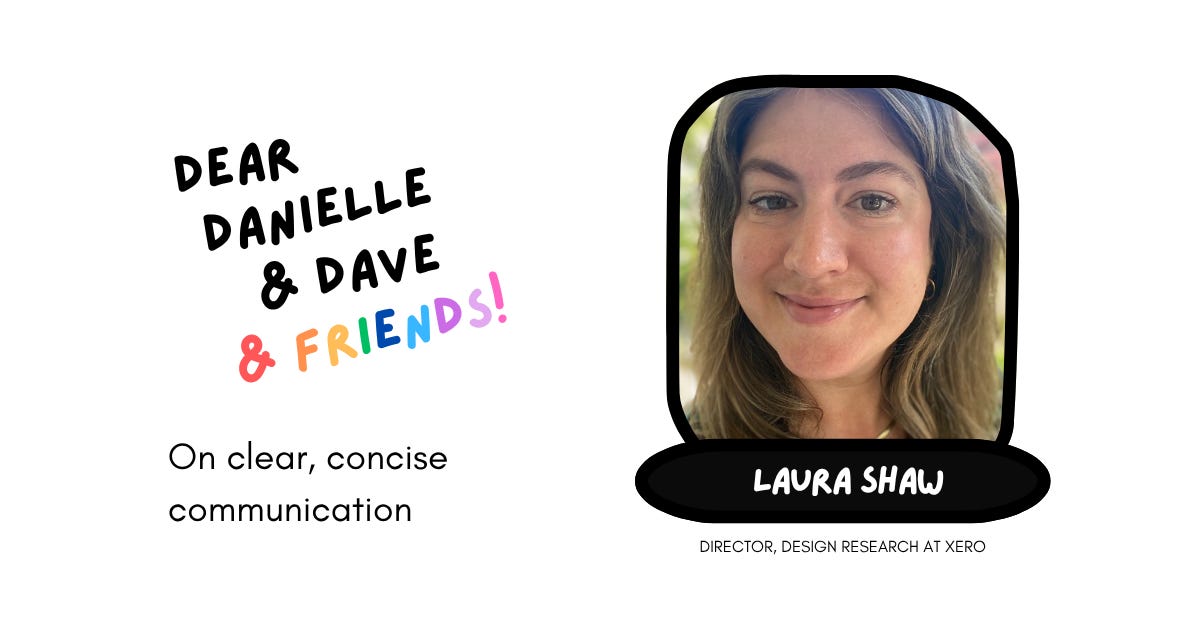
Meet Laura Shaw. Laura has been in the industry for a hot minute, with roles in tech, service design, and now at Xero leading a global research team. Below is an edited summary of our conversation focused on key insights.
We discuss:
Why communication is an underrated skill at the workplace
What is the most common pitfall that most people fall into
How to reframe communication so it lands better with your audience
Best advice she learned from her mentor and now lives by
Your career path, like many UXers, is diverse and winding: ESL teaching in Japan, grad school philosophy papers, nonprofit comms, UX writing, and eventually research. When you trace it back, what’s the story arc that connects all of it?
“With each job it was like different ways of honing my communication skills. By the time I entered into product and was doing all this UX writing, I was writing interface copy, support guides, trying to help people move through experiences by giving them language. And what I learned after about six months or a year of that was that nobody actually reads. And if you’re trying to solve UX problems through the right button copy, you are lost. You’ve already fucked it up.”
“That is what got me into research. Language is just another form of design. If you watch people use things and watch where they get stuck, you realize they don’t read a single word. You have to learn how to design things crisp and clear and intuitively so that the words (almost) don’t even matter.”
And when research became the job; what was that moment like?
“Wait — is this a job? I can do this and get paid? I was an anthropologist, a detective, a spy, a therapist, an explorer, a builder, a designer, a writer. And I got to talk to people all day. I got to take the pain that they were in and tell stories about that pain to product, to engineers, to designers — to help them fix that pain.”
You chose clear, concise communication as your topic. Why does it matter so much to you?
“You can do the most amazing research in the world. Uncover the most fascinating insights ever. You can create the most brilliant designs. But if you can’t share them in a way that meets your audience where they are, they don’t matter. We’ve all been in presentations that were so boring your eyes glaze over. The person can be a genius. If they’re boring, if they’re jargon heavy, if they spend a million years on theoretical stuff you don’t care about, it’s not gonna land.”
“Good communication is also knowing how much to do.”
So where do people go wrong?
“The most common pitfall is they start with here’s how they want to tell this story. Which is wrong. You start with your audience. What do they care about? How time poor are they? What kinds of decisions do they need to make off the back of it? Are they reading this at their desk, on a plane, walking their dog?”
“So many people will share “here’s what I did and here’s how I did it” — and then they get into what matters? Nobody gives a shit. Figure out what people actually care about, give them that, and put everything else in the appendix.”
Some ICs might push back and say, isn’t the quality of the work what matters, over the communication of it?
“If you’re gonna be a good designer, you have to be curious, have good ideas, be able to build the prototype, have the technical skills. That’s the job. But if you can’t present that in a way that gives confidence in your work, it’s just not enough.”
“I gave feedback to a designer recently and what impressed me wasn’t just the thinking — the thinking was great, but that’s a given. What impressed me was she gave me exactly the right amount of context upfront so I knew why I cared about it, why it matters to our users, what the problem is. I felt supported. It’d landed. Because she was able to frame it up appropriately, we were able to give amazing feedback. She got what she needed. We felt confident in her approach. That’s why the communication element is as important as the work.”
“…but if you can’t share them in a way that meets your audience where they are, they don’t matter.”
What about content designers, does any of this conflict with what they do?
“The fact that people don’t read doesn’t mean we don’t need words. It means we shouldn’t be using words to tell people what to do. We should be building things that make it obvious what to do. Content designers aren’t writing huge swaths of nonsense. They’re looking at hierarchy, human behavior, what people care about — and delivering that in the tightest, smartest, most strategic way possible.”
This reframe of research outputs and communication as products in themselves. Can you say more about that?
“We have two types of users. We have the users of the software our company builds. And we have the research users — execs, heads of product, GMs, PMs — the ones making strategic decisions. We build different products based on who the stakeholders are and the types of decisions they’re making.”
“We don’t have a default that a project is going to culminate in a report. Sometimes the results should be a spreadsheet. They (our stakeholders) don’t want a sexy deck. What they need is a spreadsheet with some prioritized features. Perfect. That’s all we need. So let’s not do more than that. Good communication is also knowing how much to do.”
AI is arguably making a lot of workplace communication longer and murkier. What are you seeing?
“AI is making communication both more and less clear — and it depends on what people are using it for. Sometimes I’ll open a doc and it looks super smart, all the keywords are there. But if I pull a sentence out and do a close reading of it, I have no fucking clue what it says. You don’t end up smarter having read it. That actually slows you down.”
“You don’t want to use AI to make yourself bigger and sound smarter. You want it to do the opposite. When junior team members are using AI without domain expertise, that’s when you need someone more senior to help them see that.”
Is there someone you’ve worked with who you think of as a model communicator?
“My old boss at Critical Mass, Maria. She has really crisp, pithy ways of cutting through bullshit. She had AI tell her her most commonly used phrase last year. It was: I’m not going to do that.”
“It’s not just about stating your boundaries clearly. Saying no directly means you’ll say yes to the right things. And if someone said something in a meeting that she already said, which happens to many women, I’ve seen her say: how is that different from what I just said?”
Best leadership advice you’ve ever received?
“What’s best for me is best for everyone else. If you burn yourself out, you’re not good at your job. You’re not gonna be smart at work. You’re not gonna have good ideas. I take two meetings while I’m outside walking. Is that ideal for the person I’m talking to? In a sense, no. But I have four more meetings after that. I’d rather show up fully than be up and down.”
Huge thank you to Laura for being our first interview and for the many insights she shared with us.
Laura is currently building Baba Yaga huts out of construction paper and moss, and is available to discuss that if that’s your thing, too. You can check out the “Communicating in style, with style” guide here.
Laura, your point about language being "just another form of design" is the exact wake-up call the industry needs right now. We’ve spent so much time perfecting the pixels that we’ve forgotten that our real product isn't the Figma file—it’s the clarity of the decision our stakeholders have to make.
I see this constantly in high-stakes environments. We fall into the "Rigor Trap," thinking that a 40-slide deck proves our value, when a VP usually just needs a 3-cell spreadsheet to understand the trade-off. In my recent piece on what to actually say in a Director meeting, I talk about this same idea: https://thecraftceiling.substack.com/p/directors-dont-want-your-update-heres. It's a muscle we all need to learn how to flex!
Love this! Clear and concise communication is so key to get your idea across. Thinking about it as a product is a great reframe!