


Dear Danielle,
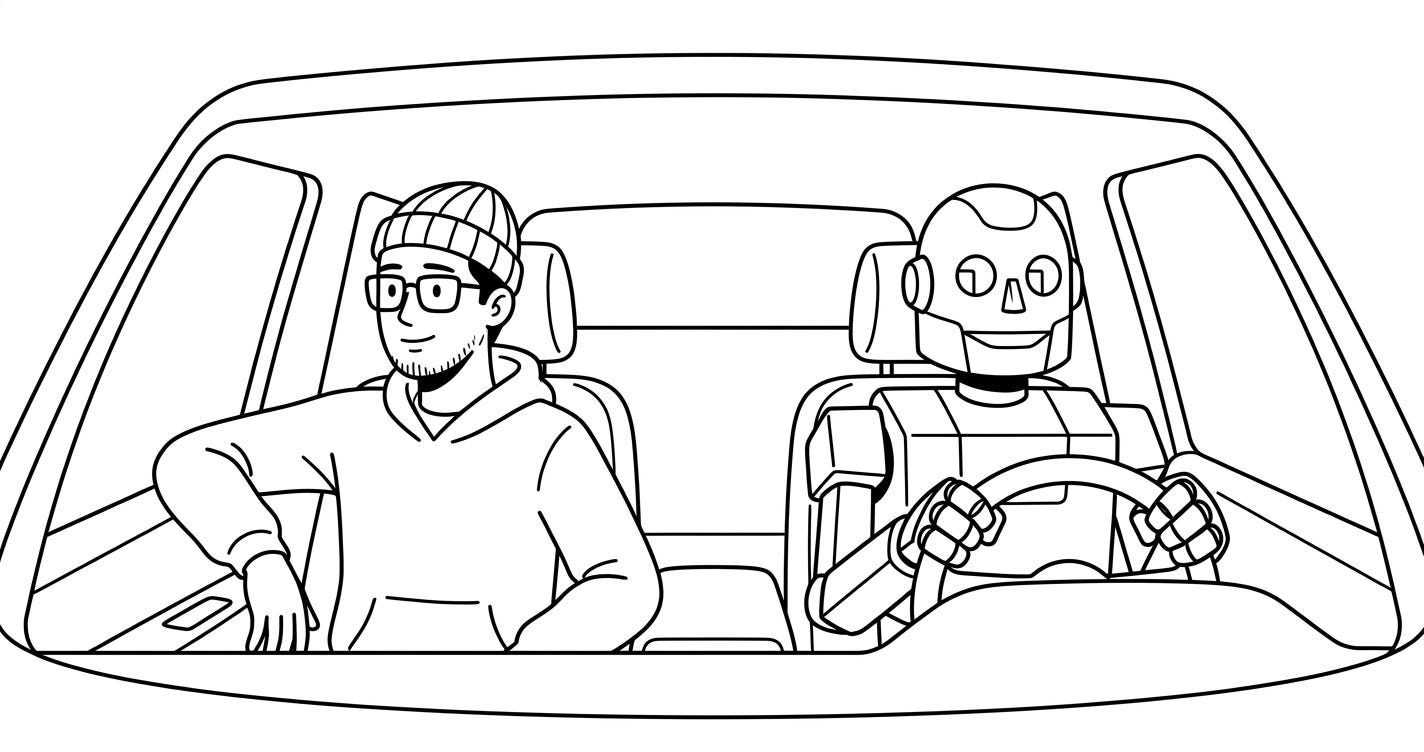
I own an EV that can self-drive, and I love it.
I didn’t always. In fact, I was pretty skeptical of the technology. I’ve always considered myself a skilled driver, certainly better than most.
But honestly, safety wasn’t the deeper issue for me. I’m far from a gearhead, but I’ve always enjoyed driving. I’ve owned a car for as long as I can remember, and there is something freeing about rolling down the window, going at a speed that’s just dangerous enough, sometimes lost in thought while listening to my favourite tunes. Cliché, I know, but there is something romantic about it. Driving has always felt like one of those rare adult activities where you are fully in command. It’s a small, daily act of mastery.
So no, it wasn’t just safety. I was worried about what I’d lose. That if I started outsourcing what I’d practiced for decades to a machine, I’d stop being good at it. That I’d become a passive passenger in an experience that used to be mine.
I think a lot of us are sitting in that exact same seat right now with AI at work.
We all have skills we’ve built over years, sometimes decades. And for many of us, those skills aren’t just things we do — they’re who we are. “UX Researcher” and “Product Designer” aren’t just titles, they’re our identities. So when we’re asked to hand over part of our craft to a machine, it feels like more than a workflow change. It can feel like giving away a piece of ourselves.
And the fear isn’t irrational. There’s a real use-it-or-lose-it tension here that I don’t think we talk about enough. If a researcher stops doing synthesis because an AI handles it, can they still call synthesis a skill? If a designer stops building from scratch because they’re iterating on AI-generated prototypes, does their craft atrophy? The muscle memory, the intuition, the hard-won instincts that come from doing the work — they’re how we became who we are professionally.
So I get the resistance. I really do.
But here’s what surprised me about my car.
When I finally started using the self-driving feature, I realized I’d been so focused on what I might lose that I’d completely failed to consider what I could gain. Driving demands enormous cognitive load. Your brain is constantly processing road signs, traffic lights, other vehicles, pedestrians, construction zones. You’re scanning for danger all the time. It’s exhausting in a way you stop noticing because you’ve been doing it your whole life.
By letting the car take over, especially on long highway drives, I got some of that capacity back. I started actually listening to podcasts instead of half-hearing them. I had deeper conversations with others in the car instead of giving them the distracted quarter-attention that driving allows. Sometimes I just sat there and thought. The irony is that the thing I was afraid of losing — that feeling of freedom on the open road — I actually found more of once I stopped white-knuckling the wheel.
So I think our relationship with AI at work can follow the same arc. But only if we’re honest about what it actually costs — and deliberate about what we do with what it gives back.
Sometimes, I still have to intervene with my EV. The technology isn’t perfect. It gets confused by construction zones, hesitates at unusual intersections, occasionally does something that makes my stomach drop. But each time I take the wheel back, I become more cognizant of exactly where the machine’s judgment ends and mine begins. The imperfections end up drawing a sharper line around what actually requires a human. And that clarity is harder to develop when you’re doing all the driving yourself, because everything felt equally mine.
I wonder if the same might be true for our craft. Maybe researchers who let AI handle the templating and transcript processing don’t lose their synthesis muscle — maybe they develop a sharper sense of where synthesis actually matters, because the machine shows them exactly where it can’t do what they do. The imperfections become a mirror for your own expertise.
Because the hardest part of all of this isn’t learning the tools. It’s grieving the version of yourself that was defined by work you’re now being asked to let go of.
Instead of turning me into a passenger, the self-driving car turned me into a different kind of driver — one who’s learning, through every glitch and hesitation, exactly when to take the wheel and when to let go.
The mastery shifts. It doesn’t disappear.
From writing this in the car while the robot car is driving,
Dave