


Dear Dave,
I’ve always loved writing. On several occasions, my father had the privilege of reading my lengthy, elaborate childhood novels, which I left in the kitchen for him to review, and yes, there would be a quiz. I’ve been documenting my emotional weather reports extensively in journals for as long as I’ve known how to write. And of course, here we are, on my Substack, another in a long string of blogs.
Some of that writing was straight off the dome —1 my journals are for an audience of zero. The goal is just to get it out, and leave it on the page.
A good edit, on the other hand, can be transformative.
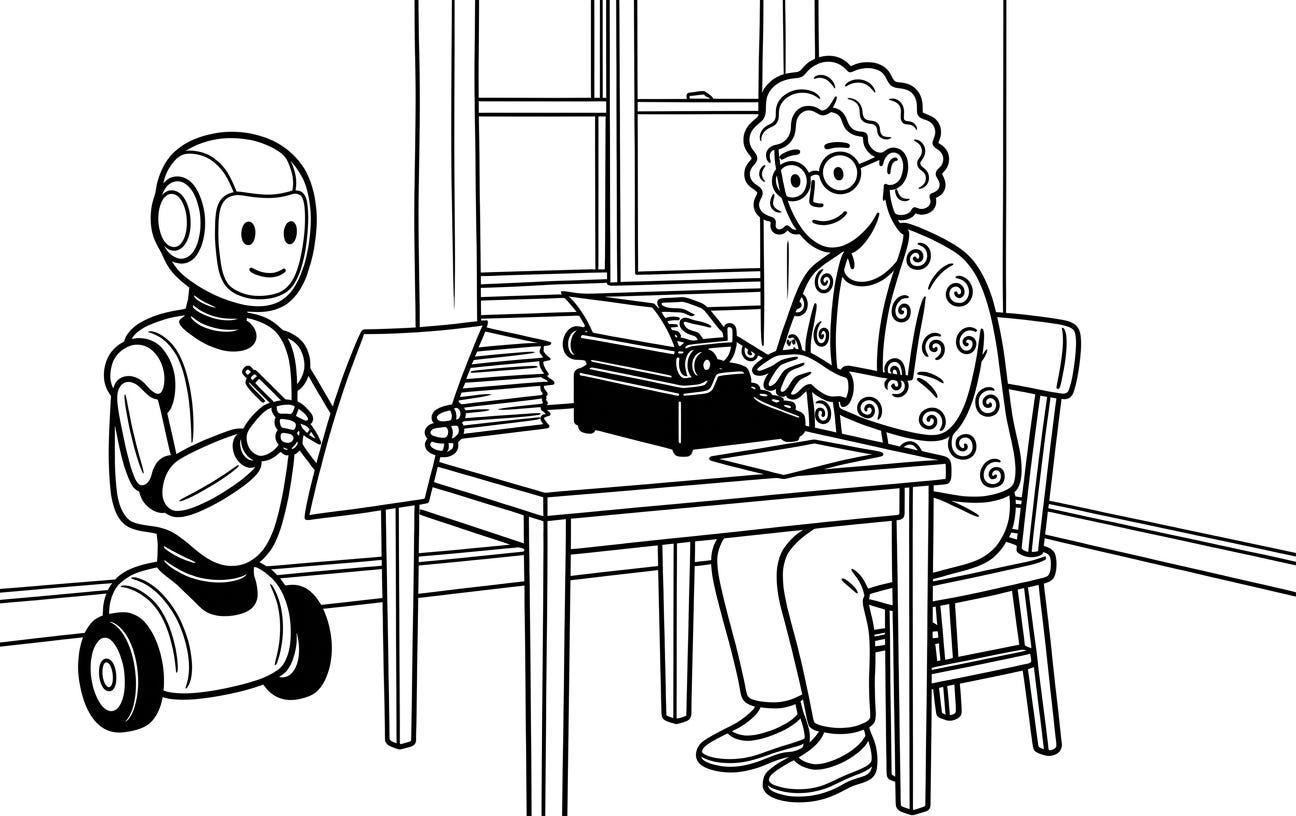
I’m not just saying this because I’m married to an editor2. Editing is just as much a part of writing, even if they’re distinct acts: to write is to process an idea — to produce an essay, you have to essayer3 — and to edit is to prepare that idea to be processed by others as well as possible, nipping and tucking, building and clarifying. Editing is thinking.
I’m hardly the first person to say that “AI slop”4 is a problem in the tech industry, but the text itself isn’t so much the problem. The problem is when people share it unedited; it’s like doing a Google search and sending out a link to the results page. Where’s the brain?
Recently, I spoke about this in front of a room of colleagues, and the response was tellingly passionate. One tactic I described was to kill your AI darlings5: “Writing with AI is a great way to save your own time, and a great way to waste everyone else’s.”
I put forward an idea I’ve seen floating around lately: as a guideline, it should take longer to make something than it does to consume it. AI is great for helping structure and refine your thoughts. Even if you start with AI-generated content for speed, it’s not worth sharing wholesale — a thoughtful edit is what makes it worth anyone’s time.
Our voices, our words, and of course what we build are how our judgement shows up. The opportunity to edit, refine, and iterate to produce something better, clearer, sharper — it’s in everything we do. So when I say kill your AI darlings, I mean it broadly: with what you write, what you say, what you design and build.
Because editing is an act of caring: considering your audience, reflecting on what truly matters to tell them, and deciding what’s a waste of precious time in a world full of distractions.
From a long day at the em-dash refinery,
Danielle.
This em dash was artisanally hand-crafted by me with my keyboard as with any that follow.
Ed. note: Hello!
To try in French for the non-Canadians!
Why, why must all our tech terms be so gross?
A classic piece of writing (editing) advice, essentially meaning, even when you fall in love with your writing, you must edit, ruthlessly. Murderously! (Said in Alan Cumming’s accent).
Yes please to editing. I just read through a VERY AI written year end review that had option A and option B of their write up for me to read. Sigh.
“to produce an essay, you have to essayer”
My writer-daughter recommended to me an interesting overview of how essays work: “Tracing the Essay” by G. Douglas Atkins. I’m enjoying it, and so I pass it along as something you might also like.