


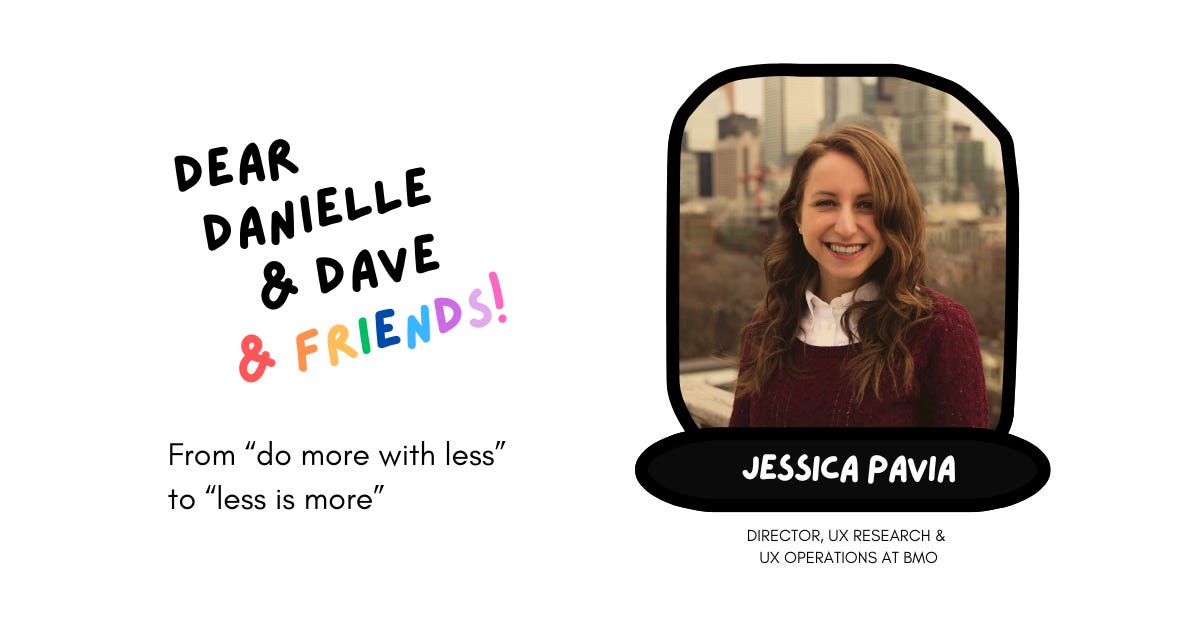
In our Dear Danielle & Dave & Friends series, we bring you interviews and letters from leaders in tech, focused on the topic they’d most want to chat about with other leaders.
Meet Jessica Pavia. Jessica leads both UX Research and UX Operations at BMO, where she supports a research team of 25 and an operations team embedded across a broader experience practice of over 110 people inside one of the more regulated, higher-stakes environments out there. Before BMO, she built her career at IBM and helped establish a design research discipline at Loblaw Digital, taught applied research methods at Seneca and Sheridan, and has spent most of her career, by her own account, in the business of patterns, which she traces back to being a kid obsessed with Where’s Waldo.
Jessica came to us with a mandate that’s been following her around for most of her career: “do more with less.” She’s got a lot to say about what that phrase actually means, what it doesn’t, and how she’s learned to translate it into something a team can act on without burning out. Below is an edited summary of our chat.
We discuss:
Why “do more with less” isn’t a euphemism for working harder, and what it actually asks of a team
The question she asks before approving any plan: what would you do with half the time?
Where she’s found the highest-leverage place to cut, and the one thing she’s refused to
What efficiency looks like in a highly regulated industry
Why AI only earns a place in her team’s workflow once it’s been tested hard enough to break
You’ve been handed “do more with less” more than once in your career. What does that phrase actually mean to you at this point?
It means be intentional. Every process, every meeting, every investment has to earn its place. I think about this a lot through the lens of my grandmother, who’s Italian. She used to say “meno è più”, which literally means “less is more”. And it took me a long time to understand what she meant by that in a work context, because the blunt interpretation of “do more with less” might be perceived as simply working harder.
So a few years ago, when that mandate came down to my team, I introduced a simple quarterly check-in. Once a quarter, I’d ask researchers about the work they were doing: the types of studies, the volume, how fast things were moving, how many insights were actually driving action downstream. It wasn’t rocket science.
But what emerged wasn’t just the data. It was the story: where teams were thriving, where there was friction, where we had real benchmarks instead of vibes. That’s the difference between doing more with less and just doing more.
How do you actually turn a vague mandate like that into something your team can execute?
I’ve been trained to never measure change without a baseline, so that’s always the first question: where are we starting? A lot of leadership, I think, comes down to storytelling: figuring out what story you want to tell about where your team is creating value, and then finding the data points that support it. If you’re a leader, that might be the story of how your team’s working and where you’re seeing improvement. If you’re an individual contributor, it might be the story of how you refined a process or looked at a problem differently to save time or money.
For example, we focus heavily on removing friction through tooling, but every tool has to earn its place in the stack. We spend real time piloting before we adopt anything, which takes longer than some faster-moving industries might tolerate. What I won’t compromise on is anything that touches risk or customer trust. Those aren’t trade-offs to me. I think of them as foundations.
Banking has a reputation for moving slowly. How has working inside that constraint actually shaped how you think about efficiency?
Honestly, before I joined banking, I heard “banks move slower” a lot, and I was hesitant about it. But I’ve come to see it differently. When you’re helping people manage their money, their security, their future, that’s a real responsibility. (Yes there are) more stakeholders, more approvals, more regulatory considerations. That’s just the nature of the environment, and it’s how you choose to see it. I think about those constraints as a creative challenge. Some of the best work I’ve done, and the best work I’ve seen from my teams, has come out of working inside them.
I say to my team a lot: we move as fast as we can, but with rigour — that doesn’t get compromised.
And practically, there’s a question I ask constantly when someone brings me a research plan or a new workflow: what would you do if you only had half the time? Not because I want people to work faster for its own sake, but because the constraint reveals what actually matters. When everything feels important, it’s hard to know where to focus. I also push my team to bring multiple plans, not just one: show the different costs, the different options, and if we only had one bet, what it would be?
Is AI genuinely buying back capacity for higher-value work on your team, or is it just one more thing to manage?
I’m in the camp that it’s genuinely buying back capacity, with a heavy dose of caution attached. I’ve seen researchers, designers, and operators use it to simplify the repetitive work that doesn’t create much value on its own, which creates more room for the things humans are uniquely good at: critical thinking, judgment, connection. But I’m curious to a fault, so my excitement always comes with caution. I believe in piloting before scaling, and honestly, trying to break a tool before I trust it.
I don’t think of AI as valuable because it’s evolving. I think it’s valuable when it earns its place, the same standard I’d apply to any tool. Where does it actually earn its place in the workflow? Is it enhancing the work or breaking it apart, and how are we testing that?
The goal was never just about doing more. It’s about creating room for the meaningful work, and figuring out how AI can help with that.
Lightning round
Best leadership advice you’ve ever received?
Early in my career, a leader I worked with forwarded me along an invite to a meeting with an executive team. I wasn’t presenting, wasn’t really expected to say anything. But before we went in, she asked me one question: what are you bringing in with you? It reframed accountability and leadership for me completely. The goal was never just to earn a seat at the table. It’s to contribute something meaningful once you’re in it.
Who’s a work bestie who’s helped you along the way?
Christina Cornacchia. We were research leaders together earlier in my career, growing and supporting teams side by side. She has this rare combination of pragmatism and empathy; I could bring her almost anything and she’d cut through the complexity without ever losing sight of the people involved. I joke that she’s on my board of directors for decisions. The higher you go in leadership, the fewer people there are who truly understand the weight of what you’re carrying, and Christina’s one of the people who reminds me I don’t have to figure it out alone.
Huge thank you to Jessica for joining us and for the reminder that “less is more” is a discipline, not a shortcut.