


In our Dear Danielle & Dave & Friends series, we bring you interviews and letters from leaders in tech, focused on the topic they’d most want to chat about with other leaders.
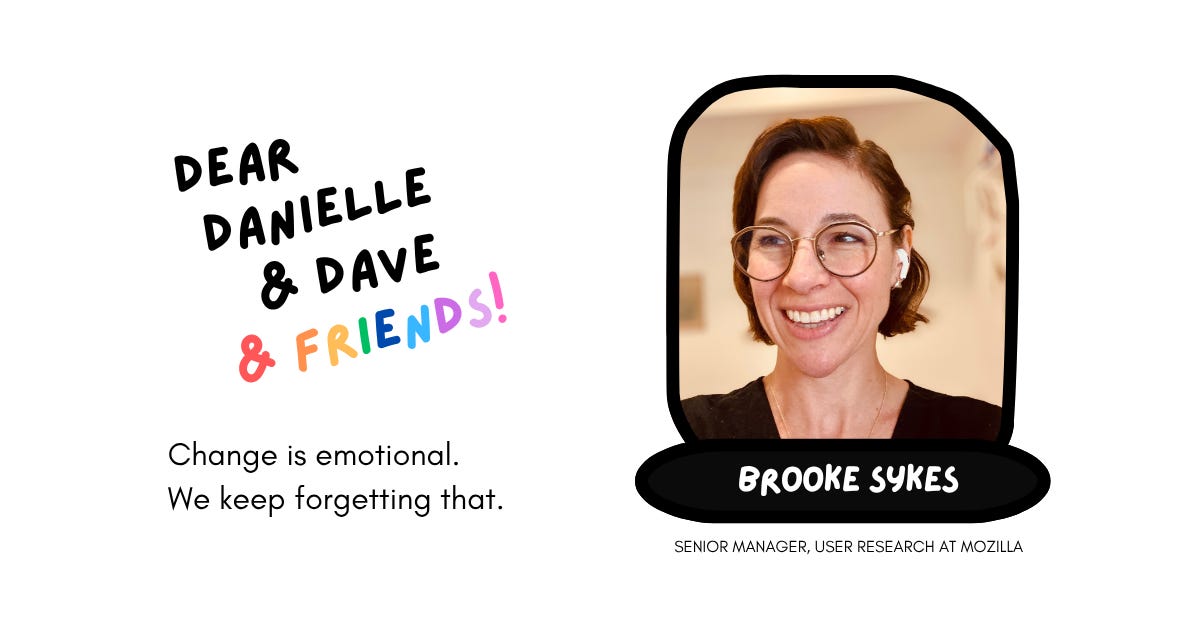
Meet Brooke Sykes. Brooke's career started in academia before pivoting into policy research with the Ontario government, and then into tech at Mozilla in 2022, where she now manages a user research team. She came to us with change management on her mind, and we got into the often underrecognized emotional side of navigating change. Below is an edited summary.
We discuss:
Why change management is the defining challenge of this moment in tech
The gap between a mandate and a strategy your team can actually use
What researchers’ instinct for scepticism looks like when you point it at AI
Why not having a playbook might be the most honest thing a leader can offer
The emotional dimension of change that tends to get skipped over
You chose change management as your topic. Why is it top of mind right now?
I think it’s really the defining challenge of the moment that we’re in in tech. With change brought about by AI, but even in the last few years — teams contracting, layoffs happening — people are grappling with those changes.
And specifically right now, the change management involved in taking a mandate like use more AI on your team. We have more AI tools available. They can unlock really great things. But translating that mandate into actual change that people on my team can adopt, can feel good about — things can get really, really fuzzy in there.
So how have you approached it?
I try to be really transparent — share whatever information I get about what the expectations are across the org, and then get the team’s input. Really have an open discussion: how are you feeling? It’s okay to have questions and doubts. We can learn about this together.
And one of the things that has come back to me a lot as a leader is that you don’t need to have all the answers. I’ve really tried to communicate that we are figuring this out together. Nobody really has it figured out at this point.
What are the most common pitfalls you see in communicating change?
One is the emotional dimension. Change isn’t just a new tool or operational. It’s the people behind it. A lot of our professional identities are bound up in our expertise — and right now, some of that expertise needs to be expanded and rebuilt. That can be tricky.
The other one is that gap between a mandate and a strategy that the team can actually employ. Even well-intentioned mandates can stall if there’s no clear strategy: what tools, how do I use this, how do I still verify the work? That’s the messy thing we’re working out right now.
Researchers tend to be skeptical by default. What does that look like when you point it at AI?
With researchers, the default stance is one of skepticism, critical thinking: can I trust it? Is it good quality? And if you throw in a black-box AI technology, all sorts of spidey senses go off.
And I think that’s okay to have those questions. My team asks really smart questions — some that give me pause and make me think more even about the technology.
When we mapped out our research process to figure out where AI might fit, it became clear that some folks weren’t really thinking about it as I use AI for this or that. They were already embedding it into their entire day — using it as a thought partner, asking it to poke holes in their work, doing a first pass of synthesis and then asking an LLM to check what they might have missed.
So there isn’t one way to use it. And how you match the different ways of using AI to the context you’re in — level of risk, timeline, what the stakeholders need — that’s where the judgment comes in. I first thought I’d create some kind of model everyone could adopt. I’m less and less thinking that’s possible. It’s more about understanding the technology and the contextual constraints and making a really good decision.
What about harder changes — personnel changes, layoffs?
Even when a few people are let go, it’s emotional. It’s okay to feel sad about it, and to give people time to process it. Sometimes we’re losing people who are friends, or part of our work community. It can bring up job security anxiety: why them? Am I next?
I try to share information as soon as I get it — whatever I’m able to share, I pass it down so folks hear it directly, and don’t have to fill gaps of information with assumptions.
And it impacts people in different ways. I’ve always been touched when people have reached out to me too — acknowledged that even though I hold a leadership position, it’s impacted me as well.
Is there a playbook for any of this?
I wish there was a playbook for everything. But admitting when you don’t know the answer — I think that can go a long way in building trust with the team.
I think that was part of my trepidation stepping into a leadership role: people are going to turn to me and want answers. But getting really comfortable with nobody does — saying, I don’t have all the answers, we can figure this out together — has felt right. We’re going through this together.
Lightning round:
Best leadership advice you’ve ever received?
That you don’t need to have all the answers. You just need to know how to find them.
A previous boss of mine had this really effective approach — she’d put some of my questions back on me. Not just what do you think we should do, but: what would success look like in this scenario? What are our options for getting there? What do we want to try next? When I later took a coaching workshop, I recognized that framework immediately.
Now I try to resist the temptation to jump straight into problem solving. Somebody on your team asks a question and you want to say, well, I think you should do this. But sometimes I’ll take a beat and say: what would success look like here? Let’s talk through the options and land on something together.
Who’s a work bestie who’s helped you along the way?
I feel lucky that I’ve had a work bestie at pretty much every job. What they give you is someone to celebrate the wins with, but also to talk about the challenges — the highs and lows. Just having a trusted person who’s there for both has been really important.
(Brooke ultimately gave a shout-out to Eric Pang, who she described as a sweetheart, a talented designer, and someone who is always down to chat through a work challenge. This was very wholesome.)
Anything you’d like to plug?
Brooke and her team are hiring a Senior User Researcher at Mozilla in Canada.
Huge thank you to Brooke for joining us and for making us feel considerably better about the fact that we also don’t have it all figured out.
Brooke is based in Toronto, has been to Amsterdam and recommends it enthusiastically, and has many work besties. You can find her on LinkedIn.