



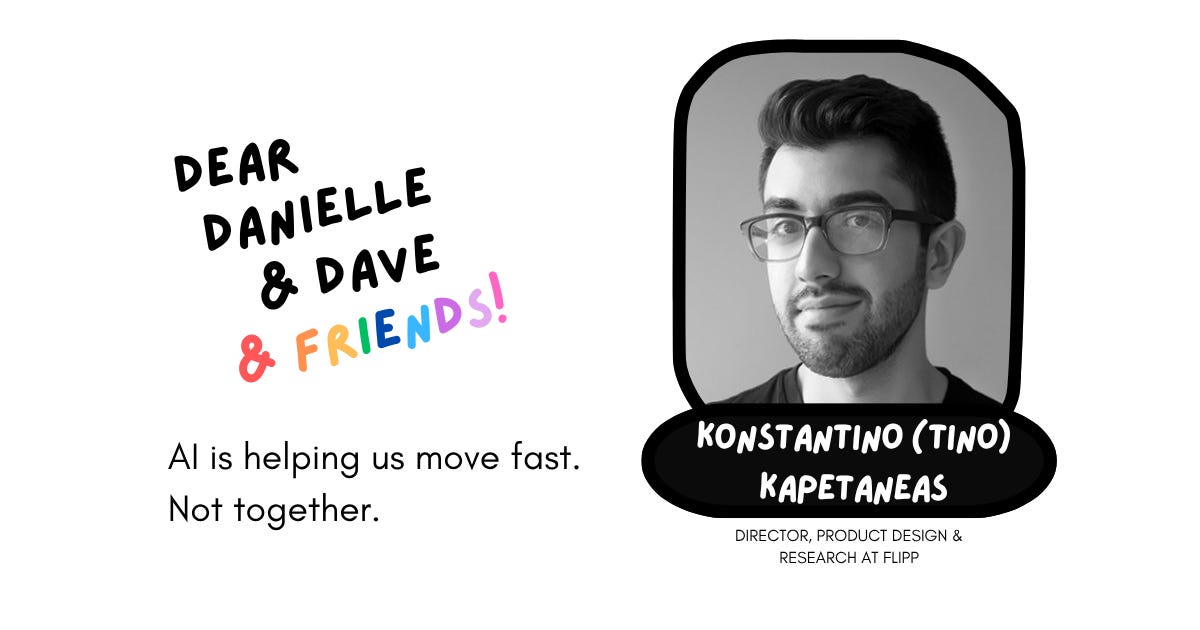
In our Dear Danielle & Dave & Friends series, we bring you interviews and letters from leaders in tech, focused on the topic they’d most want to chat about with other leaders.
Meet Konstantino (Tino) Kapetaneas. Tino is Director of Product Design & Research at Flipp, where he’s led and grown the function for nearly eight years, building the UX research practice from scratch, scaling a 27-person team, and helping evolve the company’s product from a single app to a multi-product ecosystem. Before Flipp, he cut his teeth on the agency side in digital health, doing formative work with patient advocacy groups that, by his own account, set the direction for everything that followed. Dave and Tino are also old colleagues; and if you’re wondering whether they’re real-life besties, Tino’s official position is that he can neither confirm nor deny this. Tino has previously written for us and we were very excited to have him on the pod!
Tino came to us with something that’s been eating at him: AI is making teams skip the alignment work, and we’re starting to pay for it. Below is an edited summary.
We discuss:
Why AI-enabled speed is surfacing alignment problems that were always there
What happens when four stakeholders ship four competing prototypes before anyone’s written a brief
The case for participatory design process — and why designers’ instinct to protect their territory is working against them
Why functional culture, as we’ve built it, might be part of the problem
What the design brief is doing now that the PRD used to do
You came in with a pretty strong take. What’s prompting it?
A few things. The first is kind of funny. We just did a company offsite with a Dragon’s Den–style pitching competition: use AI to build a new retailer brand from scratch, in 90 minutes. My team — people who’d never worked together before — came out with a deck, a valuation, a pitch to investors, and a theoretically functional prototype. We won.
Here’s the insane part. I won the pitching competition not really knowing what my business was all about or how I was going to run it. I don’t know the first thing about how to run the business I pitched. And I think that kind of underscores what we’re seeing with a lot of the outputs coming through AI-enabled workflows right now.
The second example is less simulated. I was part of a project recently where, at the very early stages, four different stakeholders had each built their own prototype. Nobody asked them to. None were made by designers. There was no product brief. That was how the project started.
What I found really interesting about that early stage was how difficult it was to decide what to do next. What were we evaluating these outputs against? What problems were we trying to solve? How would we know if we were going to be successful? And ultimately, the only way out of that stage — where you have four or more competing ideas, all high-fidelity, all very convincing — was to defer to the loudest or highest-paid voice in the room.
That’s a problem we’ve all struggled with throughout our careers. But with AI, it’s becoming way more common.
Is this AI breaking the process, or exposing what was already broken?
Both, I think. On one hand, I’m concerned about the dysfunction being cultivated as a consequence of this technology. At the same time, it does start to poke holes in the old guard — how we used to operate. And some of those holes were always there.
Take something small: have you ever had a PM request a Figma licence and quietly bristled at it? I say this facetiously, but I think designers can be sort of gatekeepy. Is that conducive to creating the best work possible? Probably not. And now that AI is giving product managers and engineers capabilities they didn’t have before, they’re looking over their shoulder at designers thinking: do I still need these people? The best way to counter that is to stop protecting the territory and start participating in a collective process.
So how do you coach your team through this?
The first thing I’d say is that what teams are experiencing right now, a lot of the time, is a vacuum of leadership. I don’t mean that to be extreme. I just mean that when everyone’s looking over their shoulder wondering if they can trust the person next to them, that’s often a consequence of there not being clear guidance about what to do in an ambiguous transformation moment. And you can point up to the executive layer and blame them — a lot of people do, and I struggle with it myself sometimes — or you can choose to find a path in the chaos and work with your peers to make progress along it.
More crafts-oriented people — designers and researchers especially — can be uncomfortable stepping into that leadership role. So a lot of what I coach my team on is: how do you label and manage uncertainty, and how do you step into that role even when your title doesn’t call for it? Go build relationships with the directors in other functions. That might seem like overreach, but sometimes you need to go up the influence chain before you can move anything laterally.
The other thing: write the brief. We’re seeing a world right now with less and less upfront documentation — no PRDs, no requirements, just outputs. So some of my team is picking up that slack. They’re writing UX briefs, articulating the problem, scoping what’s possible. Not because it’s a designer’s job, but because someone has to create something that people can align to. Even if it’s incomplete. Even if it’s imperfect. Just something to anchor to.
What’s the bigger structural shift you’re pointing at?
This is the uncomfortable part. I think horizontal functional leadership — the investment we’ve made in building functional teams, functional culture, functional identity — is going to have a hard time over the next five to ten years.
I pride myself on the product design and research culture I’ve helped cultivate at Flipp. And that’s a selfish viewpoint. Because what it also does is reinforce silos, even when we’re trying not to. And I think the next leg of our evolution is going to force us to come to terms with that.
In practice, what that looks like at the individual level: stop designing in a silo. Invite your PM and your engineers into your design critiques. Not just other designers. Yes, you’ll have untrained voices in the room — that’s uncomfortable. But that’s also how you build a joint culture around making products. The best teams I’ve ever been on worked that way: T-shaped people, a lot of trust, a lot of improvisation. You were playing jazz. And misalignment doesn’t just create dysfunctional teams — it ships to the products themselves.
Lightning round
Best leadership advice you’ve ever received?
Not from anyone who told me directly — I’m going to be lame and quote Steve Jobs. There’s a video from the early nineties where he talks about how the best managers come from craft experience. They need to know how to make things. They need to be great executors first, because the people working with them want to learn — and you can only teach what you know how to do.
That’s how I’ve built my people leadership layer. Great craftspeople first. The behaviours follow from that.
Who’s a work bestie who’s helped you along the way?
I have to give Dave a quick credit — he’s been incredibly supportive of my personal fitness journey, and I’ve built habits from time spent with him in the gym that I’ll carry the rest of my life. Outside of that: a product director peer at Flipp who’s just gone on maternity leave. She’s been a huge advocate for good product operations, standardised documentation, better roadmap practices. I don’t think I’d be nearly as involved in cross-company operations without the doors she helped me walk through. Genuinely grateful for that partnership.
Plugs
Tino just pre-launched his first home-built SaaS product: Acorn Pad, a privacy-focused digital note-taking app he built himself using AI. There is a floating teal squirrel. We enthusiastically recommend checking it out.
Huge thank you to Tino for joining us, and for articulating something many of us have been feeling but not quite naming.
Tino is based in Toronto and is indeed Dave’s gym buddy. You can find him on LinkedIn.